Is an AI Tutor as Good as a Human Tutor?
No. It isn't. Let's just say that up front, because dancing around it would be dishonest, and honestly, insulting to every good teacher out there.
A great human tutor, sitting across from your kid, watching their face, catching the exact moment confusion turns into a real breakthrough, is still the best way to learn something. Nothing an AI does right now replaces that. If the question is "which one teaches better," the human wins. Full stop.
So why are we building an AI tutor at all?
The real problem isn't quality. It's scale.
Here's the thing nobody says out loud enough: teaching one kid at a time works beautifully. Teaching thirty kids at a time, in a classroom, all at different levels, all stuck on different things, is a completely different job. You cannot give each child in a room of thirty the same attention you'd give them one on one. It's not a matter of trying harder. It's math. There are only so many minutes in a class period and only one teacher.
That's the actual gap AI tutoring is trying to close. Not "is the AI as good as a person," but "what happens to the kid who needs one on one attention and can't get it, because there's one teacher and thirty kids, or because a private tutor costs more than the family can spend."
And a good private tutor is expensive. The ones who are actually skilled at it, who know how to diagnose why a kid is stuck rather than just re-explaining the same thing louder, charge accordingly. That's fair, their time and skill are worth it. But it means one on one tutoring, the kind that actually works, ends up being available mostly to families who can afford $60, $80, $100 an hour, on a schedule that fits a tutor's calendar, not a kid's actual moment of need.
So most kids get neither. They get a classroom where the teacher can't get to them individually, and no affordable way to get real one on one help when they're stuck at 8pm on a Tuesday.
Teaching is a skill. Not a fallback.
There's an old, tired line that gets repeated way too often: those who can't do, teach. It's wrong, and it's worth saying clearly why.
Knowing a subject and being able to teach it are two completely different skills. Plenty of people who are excellent at math cannot explain why a particular kid is stuck on fractions. Good teaching means diagnosing a specific misunderstanding, not just a general one, choosing the right explanation for that specific kid, reading whether they're actually confused or just frustrated and need a break, and knowing when to push and when to back off. That's a real, learned skill, and the good teachers who have it are doing something genuinely hard.
That's exactly why an AI tutor without real teachers behind it is an incomplete answer. The AI can be patient, available at 8pm, and endlessly willing to try a problem a different way. What it can't do is replace the judgment of someone who has actually spent years learning how kids get stuck and how to get them unstuck.
What we actually built
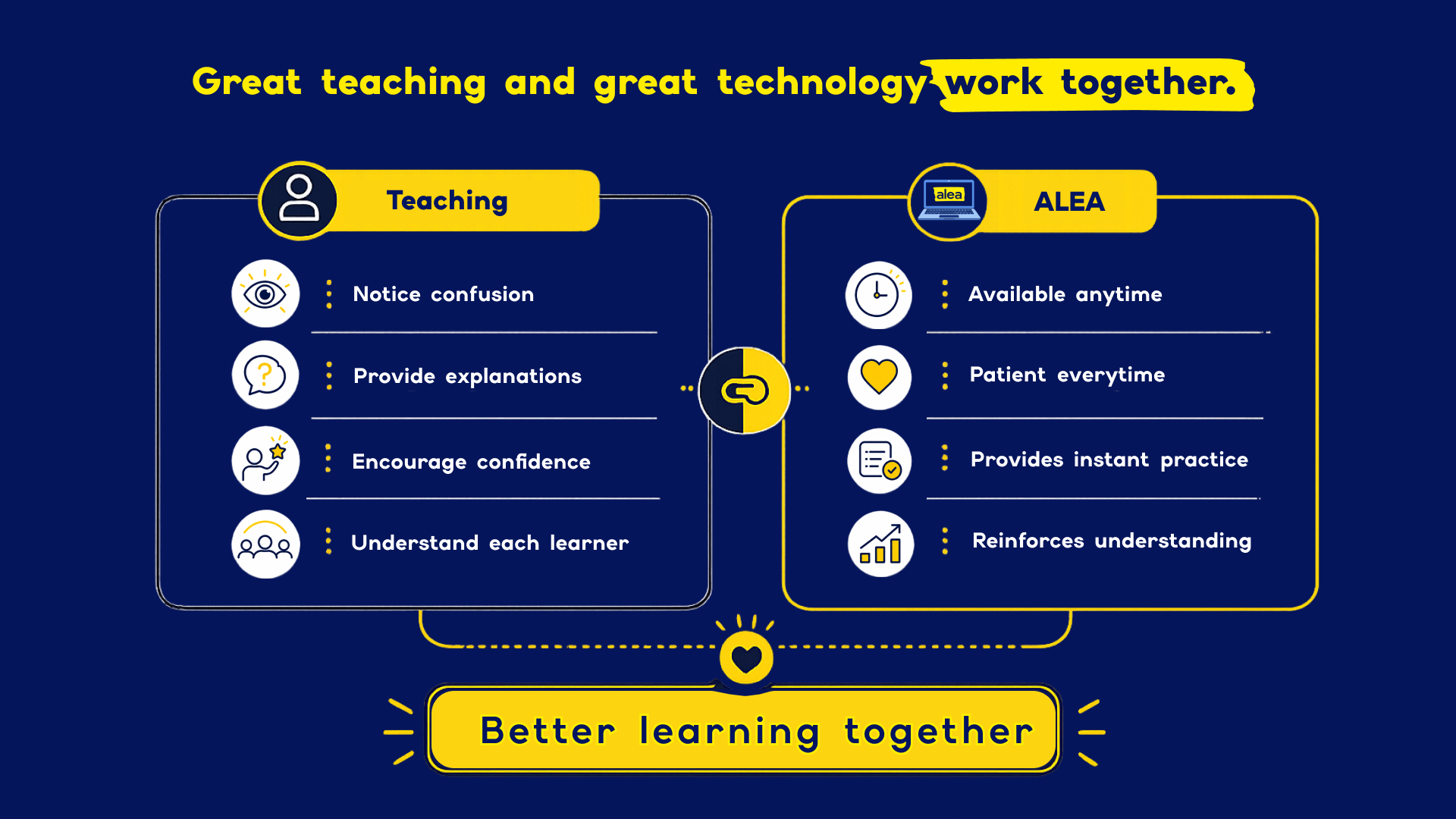
Alea isn't trying to convince you an AI is as good as a great teacher. It isn't. What we built is a way to get kids one on one attention, the kind that actually helps, at a moment when they need it and at a price that doesn't require choosing between tutoring and everything else.
The AI handles the patient, always-on, instant part. It's there at 8pm when the classroom teacher has gone home and the private tutor isn't available until next Tuesday. And when a kid hits something the AI genuinely can't resolve, a real, licensed teacher is on the other end, not a script, not a chatbot pretending to be a person.
The honest pitch isn't "as good as a human." It's "closer to one on one than most kids will ever get otherwise, and available when it actually matters."
Built around youyou, not the curriculum.
Start with a free placement and feel the difference a tutor that adapts to you actually makes.